

What Every SEO Marketer Needs to Know About Google E-E-A-T
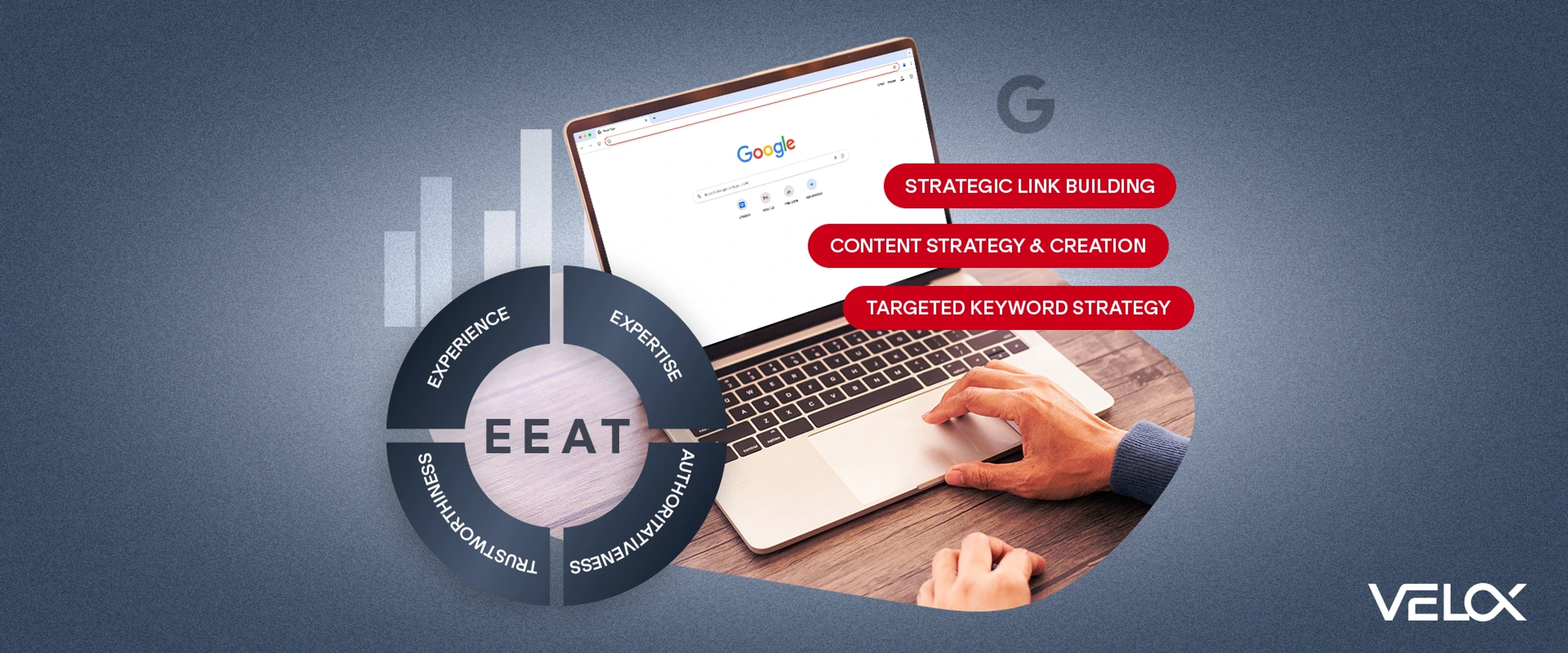

When it comes to Organic Search, you are what you E-E-A-T.
No, we’re not talking about seafood or steak dinners, but we are focusing on quality.
Since debuting in Google’s 2014 Search Quality Guidelines, E-E-A-T (then known as E-A-T) has been helping marketing teams create impactful content that captures high SERP rankings and drives engagement.
Understanding E-E-A-T and how Google uses it in its rankings is crucial to the success of Organic Search campaigns.
So, what is E-E-A-T, and how does it impact your business? Here’s what Organic Search marketers need to know about Google E-E-A-T.
What Is Google E-E-A-T?
E-E-A-T isn’t technically a Google ranking factor, but it is part of the handbook that real people, known as Google Search Quality Raters, use to evaluate websites.
Let's break down this acronym, then dive into how scores from Google Search Quality Raters impact digital content strategy.
E-E-A-T Stands For:
- Expertise: Your webpage content displays a clear and thorough understanding of a topic.
- Experience: The content producer has reasonable credibility, and the content on the page is relevant, well-researched, and accurate.
- Authoritativeness: In addition to consistently publishing worthwhile content, your site has a robust backlink profile and a strong reputation.
- Trustworthiness: Your webpage is secure, transparent, and accurate, making it more appealing to both Google’s algorithm and real humans.
Think of E-E-A-T as an equation: Expertise, experience, authoritativeness, and trustworthiness combine to create a high-quality, user-centric page.
How does satisfying E-E-A-T boost Organic Search strategies?
For over a decade, we've known that Google’s team of rating experts uses E-E-A-T when evaluating pages. Now, thanks to court documents released in September 2025 during the U.S. v. Google monopoly case, we have a better understanding of how these ratings function.
These documents revealed that RankEmbedBERT, Google’s deep learning ranking model, is trained on search logs and human quality rater scores. Using the E-E-A-T framework, human quality raters shape Google’s core ranking systems and refine search results.
E-E-A-T is one of the main pillars of their evaluation process. It ensures that pages are tailored to a human audience, not a search engine.
The bottom line: Sites that effectively demonstrate E-E-A-T perform well in search rankings.
Why Is Google E-E-A-T Important?
Every Google Core Update that rolls out brings us closer to an internet focused on the user experience.
Google wants users to quickly find what they’re looking for and trust the search results. That’s why E-E-A-T is so important.
Here are three Google updates highlighting why E-E-A-T is a timeless guideline for Organic Search strategy.
Medic Update: August 2018
E-E-A-T took center stage in the SEO community in August 2018. Google had just released the “Medic Update,” which was designed to promote websites that effectively demonstrated expertise, experience, authoritativeness, and trustworthiness to their audience.
Google Helpful Content Update: August 2022
The goal of the Google Helpful Content Update was to reward high-quality content crafted for humans, not search engines. Similarly, this update penalized low-quality, unhelpful content designed to “trick” search engines.
Google Core Update: June 2025
The latest Core Update was designed to surface better, more relevant content for users. This confirms Google’s continued push to deliver the best search results to match a user’s intent and that E-E-A-T is just as important as ever.
What do all of these updates have in common? They all strive to ensure Google queries yield trustworthy results from qualified sources. In other words, they’re designed to bring content that meets E-E-A-T criteria to the top of SERPs.
Your site needs to E-E-A-T, but thankfully, you don’t have to cook up an Organic Search strategy alone. If you’ve seen your Organic Search rankings drop with a recent Google update, it’s time to partner with an agency with experience bringing companies back to the top.
What Industries Does Google E-E-A-T Affect the Most?
At the end of the day, Google is trying to make the internet a better place for everyone. That means E-E-A-T can affect anything, from finance and health websites to fashion and gossip publications.
Google's Evaluator Guidelines focus on Your Money, Your Life (YMYL) sites. These topics revolve around content that can impact people’s health, financial well-being, safety, or the welfare of society. If poor advice can adversely affect someone, Google wants to ensure the website is high on the E-E-A-T scale.
YMYL pages can include:
- Important News
- Financial Websites
- Medical Information
- Legal Websites
- E-Commerce Sites
After the 2018 Medic Update, many YMYL sites suffered. This update underscored the importance of E-E-A-T and prompted a push for “people-first” content rather than content designed to appeal to search engines.
Ultimately, this improves the human experience of the internet. Sites that score well with E-E-A-T deliver what they promise.
If they’re a financial website, they provide accurate industry insights and trustworthy advice. If they’re an online fashion brand, they deliver relevant, on-trend advice tailored to their demographics.
When you search for something on the internet, you expect to get high-quality results. The E-E-A-T framework helps Google deliver them to you.
How Does E-E-A-T Impact AI Search Results?
AI overviews and conversational search platforms are changing the way users make queries, so marketers need to stay informed.
Optimizing your content for AI-powered search is known as Generative Engine Optimization (GEO). Here’s a breakdown of how AI overviews and conversational search tools work, and how E-E-A-T factors into GEO strategies.
Fan-Out Queries
AI overviews and conversational search tools generate responses using fan-out queries. This technique goes beyond keyword matching and related terms; AI models break up an initial query into related subtopics or questions to create a broader, contextualized response with deeper insights.
By prioritizing E-E-A-T, Google and other search engines can track down the most relevant content to create a high-quality summary or query answer.
The Importance of E-E-A-T
Frameworks like E-E-A-T allow generative engines to search the internet for reliable websites, digestible resources, and expert insights. After all, the purpose of AI-powered search is to make it easier to find accurate information and relevant content.
As GEO becomes more valuable, so does guidance from experienced Organic Search agencies like VELOX.
Here are a couple of ways VELOX helps businesses across industries amplify their GEO strategies with E-E-A-T in mind.
- Strategic Link Building: At VELOX, we publish client content across a network of high-quality, industry-relevant sites that can help boost a site’s backlink profile and authority.
- Content Strategy and Creation: We amplify brands and enhance their credibility by developing and syndicating human-generated, keyword-rich content on a monthly basis.
- Targeted Keyword Strategy: Our New Revenue Model allows us to forecast revenue gain for any given search term on Google. This game-changing model was developed from years of analyzing client data, so you know our team is creating content based on a revenue-based keyword strategy.
How to Leverage Google E-E-A-T to Boost Organic Search Rankings
In the past, tricking Google’s search engine crawlers was possible. Thin content, duplicate content, cloaking, keyword stuffing, and auto-generated content were all used to boost SERP rankings. While underserving readers and basically tricking Google, these black hat SEO tactics still worked.
Not anymore.
With each Core Update, we’re getting closer to SERPs that deliver high-quality and trustworthy content to searchers.
“We suggest focusing on ensuring you're offering the best content you can. That's what our algorithms seek to reward.” This quote from a Google Search Central blog post in August 2019 should be the basis of every piece of content you create.
If your content meets E-E-A-T standards, there’s a good chance that it will also meet the SEO requirements for ranking highly.
Just by following E-E-A-T, you’ll create pages and websites that have the potential to take some of the top spots on Google and appear in AI SERP features like AI Overviews.
What Does This Mean For You?
“Why should I care about E-E-A-T?”
Fair question.
SEO managers, marketing experts, and business owners have a lot to gain by ensuring their websites and content live up to Google E-E-A-T standards.
More importantly, they have a lot to lose by ignoring them.
Let’s look at each aspect of the acronym so you can ensure your content meets the criteria.
Expertise
When you’re searching with intent, you want an expert answer.
As far as your website is concerned, there are a few ways you can prove your expertise.
First, make sure you understand your audience’s intent. Search intent is one of the most important parts of every Google search.
If you sell women’s dresses or hiking boots, your audience probably has transactional or commercial intent. If you offer SaaS solutions, your blog might center around informational content for searchers who want to learn more about your area of expertise.
By understanding search intent, you can match your keywords and topics to your audience. This shows that you know your buyers’ tendencies and their stage of the buyer’s journey.
Finally, aim to create a website and content that’s 10 times better than anything else. This is considered 10x content. There are a few things you want to do when creating this 10x content.
First, check out the top-ranking pages for the keywords you’re targeting, and see what this content is lacking.
Do they feature infographics on their pages? Are there videos or images at the top of the post? Do they give practical advice? Any of these is an opportunity for you to one-up your competitors.
You boost your brand perception when you prove your expertise and provide 10x content. You demonstrate that you care about your customers and will provide them with the information they need. In return, they will trust you, your brand, and your products more, which can boost sales in the long run.
Experience
Experience with the content subject is paramount to catering to real people and, by extension, Google.
In a Search Central Blog post from December 2022, Google introduced the second E in their E-E-A-T rankings. Ultimately, experience is the history that a content creator has with the topic they are covering.
It’s simple and makes sense, but there’s an important reason Google added it to its search guidelines.
When you ask for a movie recommendation, you aren’t going to listen to someone who hasn’t seen the movie. How would they know if the movie is good? And that’s where experience comes into play.
Your content has to show first-hand experience to prove that you know what you’re talking about.
It can be writing content from a first-person perspective that details the author’s history with a product, or it can be content written by a team of writers who have spent time learning the ins and outs of your industry.
Experience is hard to fake. Your readers and Google will see right through it, so produce content that you have experience with, or take the time to partner with someone who does.
Authoritativeness
When Google is evaluating a page’s E-E-A-T score, the raters don’t just look at the content itself. They want the website and author to have authority over the subject.
Authority is what separates a food critic who spent 20 years as a chef and one who just started reviewing meals last week.
You’ll want to read reviews by the first critic since their authority is unquestionable.
How can your content demonstrate authority?
For starters, your content should focus on the topics readers and customers expect. When a searcher reaches the blog page of your beauty and skincare store, they don’t want to read about the latest fashion updates. They expect articles on how to care for their skin or build a nighttime beauty routine.
If you provide this high-quality content, not only can it decrease the bounce rate on your most important pages and increase clickthrough rate, but it can also encourage readers to purchase products linked in your content.
Backlinks are another way to build authority.
Backlinks are like a third party confirming the authority of a specific webpage. If different websites, content creators, and social media posts link back to your site, Google knows you have a certain amount of authority in your niche.
Building a healthy backlink profile can be a lot of work. It can be done, but it might take a while.
That’s why many brands partner with us. Our link building services increase brand awareness and improve site authority. With our help, you can become the go-to site for your industry.
Trustworthiness
The final part of Google E-E-A-T is trustworthiness. Google understands that searchers have important questions and need results they can trust, which is why it emphasizes trustworthiness so much in its evaluations.
When you visit a YMYL site, you’ll potentially receive advice or knowledge that can impact your life. A trustworthy source can give you confidence and help you make the right decision.
Building trust isn’t just a one-time thing. You have to continuously work at it.
There are lots of ways you can increase your trustworthiness, including:
- Crafting clean, error-free content
- Addressing negative customer reviews and building relationships
- Make it easy for customers or readers to contact you or your business’ customer service team
- Encourage loyal customers or readers to leave reviews on Google
- Place your business information, privacy policy, and refund information in easy-to-find locations
- Give users a smooth and uninterrupted experience
- Keep the advertisement experience unobtrusive
When you want to build trust in your website, always put yourself in your audience’s shoes.
What do they expect? What will boost their confidence? What will make an A+ experience?
With E-E-A-T (trustworthiness especially), you should aim to build a website real people will love, not just the search engine.
Improve Your Site’s E-E-A-T with VELOX
As a Google Premier Partner, VELOX has years of experience in Organic Search, paid media, and web development. We work with B2C and B2B companies across a wide variety of industries, helping them drive new revenue through Organic Search. Improving their site’s E-E-A-T is a big part of that mission.
With an in-house content team and technical SEO experts, we can help your brand improve its Organic Search rankings, appear in valuable AI SERP features, and reduce costs across the board.
Get in touch with us (https://www.veloxmedia.com/contact) to learn more about our award-winning Organic Search strategies.