

4 Myths About Ranking in AI Search
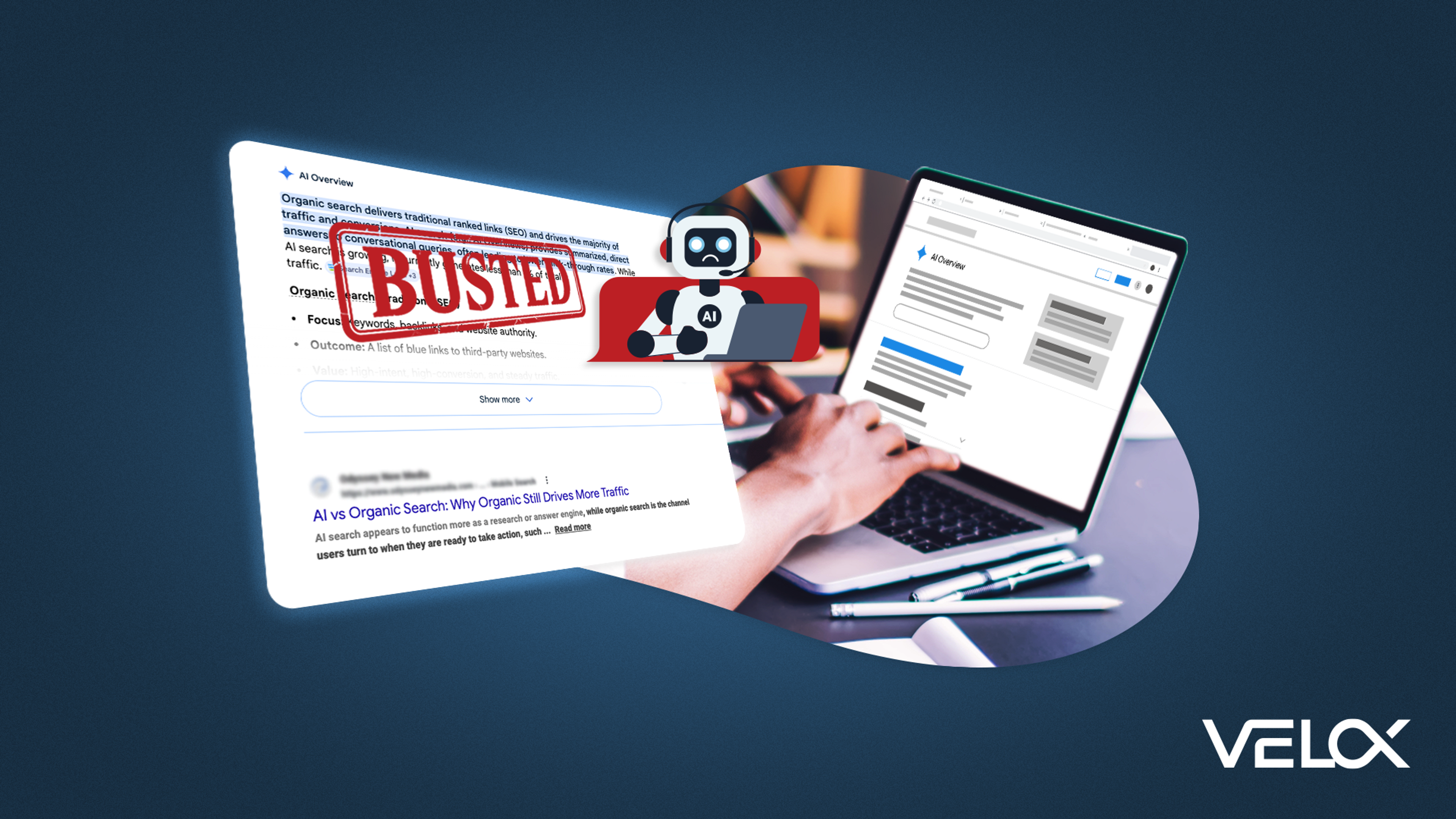

AI has dominated the digital marketing conversation for years at this point. From the C-suite to individual contributors, everyone has an opinion about AI, how it should be approached, and the value it brings to businesses online.
As expected, there are plenty of misconceptions about AI search, what visibility actually means, and whether Organic Search is dead now that AI features have become so prominent.
Some of these myths are fairly harmless, while others can pull budget, attention, and strategy away from the channels that actually drive revenue.
Here are the top four myths about AI search we’ve encountered and the truth about AI search visibility as it stands now.
Myth 1: AI Search Is a Direct Replacement for Organic Search
Let’s start with the biggest (and most harmful) AI search myth: It’s a direct replacement for Organic Search.
Ever since AI Overviews began appearing at the top of Google SERPs, the perceived value of Organic Search rankings has dropped, at least in some industry circles.
Why would someone scroll through the classic blue links if they can find the answer to their question in the AI feature?
The answer: Because the links better suit the user’s search intent.
Although AI Overviews appear for as many as half of Organic Search queries (depending on the study), AI search still skews heavily toward informational content, even as commercial and transactional visibility expands.
When someone searches for how to troubleshoot a leaky faucet, how to train for a marathon, or what color dress is appropriate for a wedding guest, they can typically find the answer in the AI Overview.
But when a user needs to hire a plumber, order a pair of running shoes, or purchase a dress, they move beyond the AI layer into organic listings, product pages, and ads.
This isn’t to mention the large percentage of users who use AI search for work. Unless they’re buying shoes on the clock, they’re likely looking for spreadsheet formulas or a quick answer to a question; not exactly relevant to e-commerce brands.
AI search is fundamentally different from Organic Search. It’s an entirely different surface that, yes, should be targeted, but only in addition to Organic Search.
There may come a day when we look back on classic Google SERPs the same way we view dial-up internet. Still, for now, AI search and Organic Search are fundamentally distinct surfaces, and Organic Search remains just as relevant as ever.
Myth 2: Optimizing for AI Search Is a Quick Process
Just because AI search isn’t replacing Organic Search doesn’t mean brands should ignore methodical AI search engine optimization practices, also known as Generative Engine Optimization (GEO).
However, many brands think too narrowly about this optimization process. Some startup AI agencies sell brands on the idea that a site audit and a quick round of technical updates will drastically improve their AI visibility.
But without a strong Organic Search foundation built upon trust, authority, and brand sentiment, these technical updates won’t move the needle.
Improving AI visibility is still very much in the experimental phase, unlike technical SEO or other disciplines. AI answer engines change quickly, public query volume data is limited, and their internal ranking systems are anything but transparent.
That’s why VELOX approaches GEO as an executable layer on top of Organic Search, allowing us to test strategies and iterate while still preserving Organic Search as the primary revenue channel for our clients.
From our research, we’ve found that GEO success largely depends on a brand’s authority, as measured by mentions on third-party, authoritative/high-traffic sites. It’s not what you say about your brand; it’s what others are saying that truly drives AI search visibility. Positive sentiment has long been vital for attracting new customers, and the same is true for AI search visibility.
So, if you were hoping a couple of site fixes and uploading an llms.txt file would be the key to appearing in AI search, we’ve got bad news for you.
However, the good news is that establishing your Organic Search presence is the most important foundation that GEO builds upon, and that’s a process we’ve fine-tuned for years.
Our Organic Search campaigns encompass technical SEO, link building, and the creation of authority-driving, citation-worthy content, all of which can help with your GEO.
Myth 3: AI Search Is Currently a Large Source of Traffic and Conversions
AI search is growing, and ChatGPT is now solidly among the top 10 most visited websites in the world. However, Google still dwarfs ChatGPT and other AI engines in overall search demand and referral traffic.
Many brands are chasing AI search because they assume that is where growth and returns are moving next. However, for many e-commerce brands, AI search is a fairly niche traffic and revenue source. That might change in the future, but currently, Organic Search is far and away the clear winner in terms of traffic and conversions.
If your AI search goals are to capture clicks and conversions from ChatGPT, you’re only setting yourself up for disappointment.
However, if your goal is to own more surfaces and integrate your brand into every stage of the buyer journey, especially during the research phases, GEO is well worth the effort. But don’t shift resources away from Organic Search toward AI search. Treat GEO as a supplemental process alongside your overarching Organic Search strategy.
Myth 4: AI Search Visibility = Market Share
It can be understandably frustrating to see competitors appear in AI Overviews.
You’ve spent years building your Organic Search footprint and have stable, high rankings, yet your competitors seem to dominate across all AI search visibility tools. It almost feels like they’re cutting in line while you invested heavily in your Organic Search rankings.
This can lead many leaders to panic, mistakenly viewing this AI visibility gap as a loss of market share.
The truth is, there is no reliable one-to-one relationship between AI visibility and market share. At least not at this moment.
Stop and ask yourself: What have your competitors gained by this AI search visibility? Are they seeing business outcomes from these citations? Have their Organic Search rankings overtaken you for high-intent, high-value keywords? Have you noticed a significant decrease in clicks and conversions?
More often than not, the answer is “no” or “remains to be seen.”
There is definite value in appearing in AI search results. It’s another surface for users to discover your brand and can lead to some traffic. However, at this moment, Organic Search still beats AI search in traffic, conversions, and ROI (the most important metrics).
Instead of pulling the plug on Organic Search and going all in on AI search (like your competitors have done), treat GEO as an added layer to your overarching Organic Search strategy.
GEO is a set of tactics to improve the likelihood of appearing and being cited within AI answers, but Organic Search remains a durable revenue-driving channel that supports meaningful business outcomes. Plus, many of the same Organic Search fundamentals, such as creating high-quality, citation-worthy content and optimizing your site for usability and crawlability, can support GEO.
So if you see competitors appearing frequently in AI answers, don’t take it to mean they have overtaken you in the market. Rankings, relevance, and conversions still matter most.
Separate Myth From Reality with VELOX
Organic Search has changed considerably in the past five years, but its value and performance remain stable. Brands that work with VELOX have successfully navigated these shifts thanks to our proven approach to link building, content creation, and technical SEO.
In addition to our award-winning Organic Search campaigns, we can help brands establish a GEO strategy that improves the likelihood of appearing in AI search results. Through technical optimizations, machine-readable, citation-ready content, and controlled prompt testing and reporting, your brand can expand its online presence across nearly every platform.
Contact us today to learn more about our leading-edge GEO strategies.