

Want Better AI Search Visibility? Start With Technical SEO

Everyone is talking about AI search.
While its revenue-generating potential remains uncertain, one thing is clear: It never hurts to expand your brand’s visibility across all surfaces online.
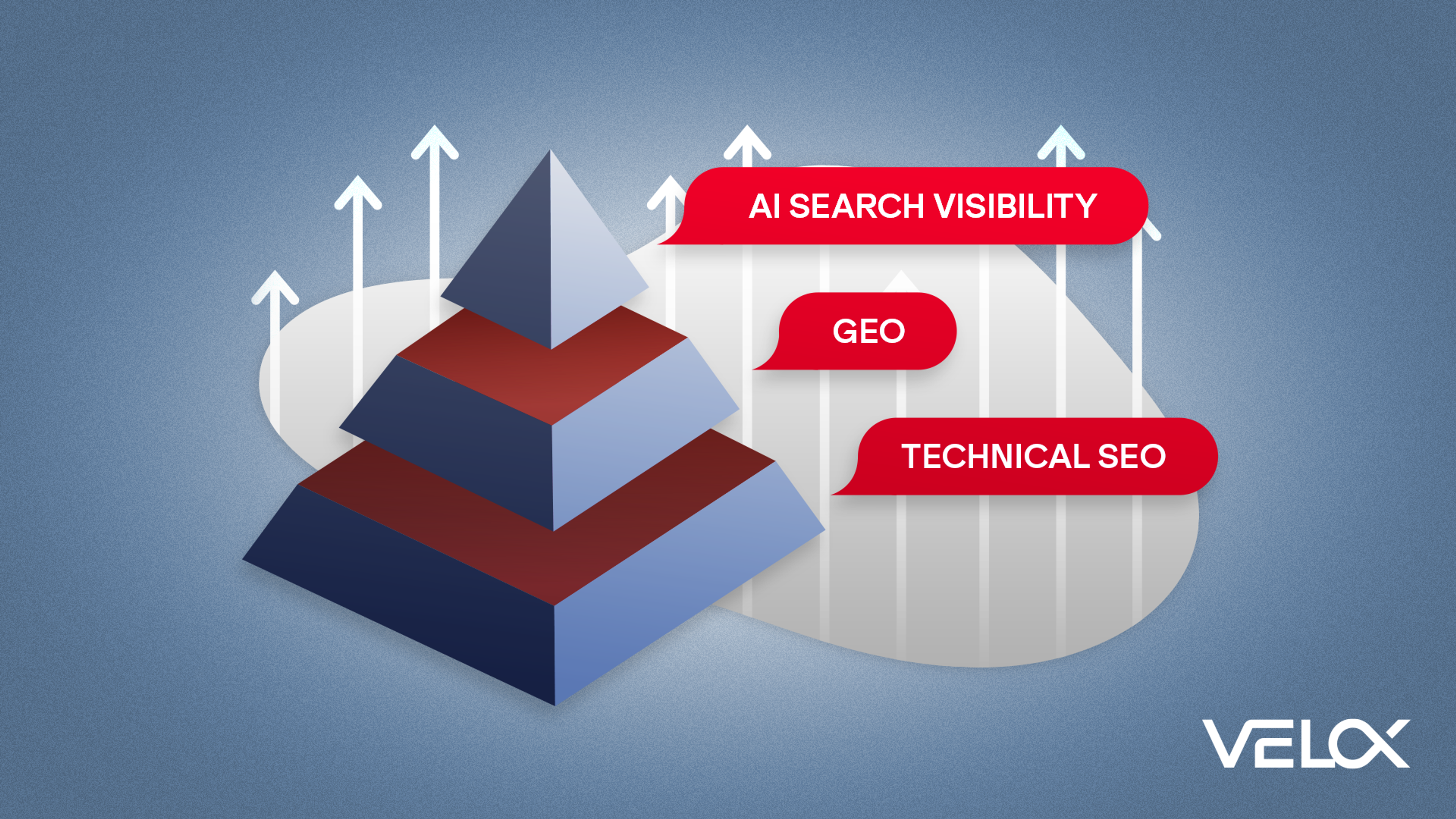
While it’s tempting to go all-in on Generative Engine Optimization (GEO), we recommend brands conduct a thorough technical SEO audit and address key issues first. Even as AI becomes further integrated into the traditional search experience, SEO is far from dead.
At VELOX, we view technical SEO as the layer that enables GEO. Combined with Organic Search, our technical SEO services ensure our clients’ sites are structurally stable, crawlable, and citation-ready for emerging AI search features.
Without sound technical SEO, AI visibility is the least of your worries. Poor technical SEO can limit discovery, impact the user experience, minimize your Organic Search potential, and reduce your overall ROI.
Before investing too heavily in GEO and AI search, here’s why a technical SEO foundation is a must.
AI Search Relies on the Same Technical Foundation for Discoverability and Accessibility
One of the top AI search myths is that marketers need to throw out the tried-and-true SEO playbook in favor of new, flashy tactics.
It’s true: GEO and SEO differ in many ways, but these differences are mostly in goals and tactics; the underlying technical infrastructure remains the same.
In other words, AI search changes the interface, but it doesn’t erase the need for sound technical SEO, nor should brands de-prioritize Organic Search in favor of AI search.
Google even admits this in its AI search guidance:
“You can apply the same foundational SEO best practices for AI features as you do for Google Search overall: making sure the page meets the technical requirements for Google Search, following Search policies, and focusing on the key best practices, such as creating helpful, reliable, people-first content.”
GEO can improve the likelihood of appearing and being cited in AI features, but it isn’t a substitute for sound technical SEO, and its revenue impact doesn’t come close to Organic Search, particularly for high-intent commercial queries.
Technical SEO vs. GEO
We’ve leveraged technical SEO to help clients revitalize their websites, improve Organic Search rankings, and drive sustainable revenue growth. One example is Mario Badescu.
The brand had a well-established brick-and-mortar footprint, but struggled to gain traction online. They partnered with VELOX for a comprehensive SEO strategy that included technical SEO, content enhancements, and keyword-focused initiatives.
After implementing on-page SEO enhancements to improve crawlability and indexing, and optimizing the site structure and UX, we helped increase monthly new organic revenue by over 250%.
Accessibility and discoverability remain vital to online performance, whether it’s a proven channel like Organic Search or an emerging one like AI search. Technical SEO is the foundation for both.
Technical SEO Improves Visibility Across AI Surfaces
Visibility is on the mind of marketers everywhere, particularly regarding AI search.
You want to dominate these surfaces so users discover your brand in AI answers and click through to your site via citation links.
Technical SEO is the crucial first step to increasing the chances of appearing on these surfaces.
Before AI systems can cite and source your content, they need to be able to find it. If your site is full of technical SEO issues, such as broken links and slow loading times, it might as well be invisible to AI systems.
Poor technical SEO doesn’t just hurt your AI search efforts, either. When key revenue-driving pages are difficult to crawl or evaluate, brands also struggle to gain traction in Organic Search, where the greatest long-term ROI is generated.
Technical SEO helps reduce friction for search engines and AI crawlers as they explore your site.
You can use descriptive headings, Q&A formatting, and other GEO best practices, but if your site is slow, has broken links, or has poor Core Web Vitals, AI crawlers will have a difficult time crawling, parsing, and evaluating your content, in addition to the problems posed for Organic Search.
Which technical optimizations support AI visibility?
Improving AI visibility starts with the same technical SEO elements that support Organic Search. These technical optimizations help boost the performance of your revenue-driving pages in Organic Search while improving their discoverability in AI search.
Focus on these primary optimizations:
- Crawlability and indexability
- Internal linking and site architecture
- Page speed and technical performance
- URL structure
- Structured data and schema markup
Technical SEO Helps AI Systems Interpret Your Content’s Meaning
Discovering and crawling your content is just the first step. Next, AI systems need to understand what your content means, its relationship to other site content, and which parts are most relevant to the user’s query.
Technical SEO is vital in helping AI systems bridge the gap between seeing content and understanding it well enough to cite it.
These LLM-powered systems can rely on text alone, but they perform much better when it is supported by clear page structure and contextual signals, both of which are core tenets of technical SEO.
This includes a logical heading hierarchy, robust internal linking, and strong information architecture.
Structured data also plays an important role. In Organic Search, it provides helpful clues that help crawlers classify the content (HowTo, FAQ, Article, etc.). This enables your content to appear in rich snippets and results. Structured data serves a similar purpose for AI search, helping crawlers better understand the page’s purpose, the entities referenced, and how different elements fit together.
While nothing is guaranteed in AI search, these technical optimizations help AI systems understand your content and improve the likelihood of being cited in AI answers.
How does technical SEO help AI systems understand website content?
Technical SEO provides the necessary context and structural clues to AI crawlers, enabling them to better interpret and classify your site’s content. Technical optimizations such as structured data, heading hierarchy, and internal links help AI systems better understand what a page is about and how it relates to other pages. This enables a more accurate interpretation when connecting high-value content to a given user query.
Citation-Ready Content Requires Sound Technical SEO
Your content has been found, crawled, and “understood” by AI, but is it extractable? Unlike traditional Organic Search, where the primary goals are rankings and conversions, the goal of GEO is to be cited in AI features. This means your content needs to be citation-ready and built upon a machine-readable framework.
Again, technical SEO reduces this friction and ambiguity, ensuring your content can be easily extracted and cited. You’ve invested heavily in the content and development work behind these pages; technical SEO helps you maximize your return on this investment.
Your focus should be on clean page hierarchy, purposeful internal linking, stable performance, and clear HTML structure. These optimizations help AI systems identify the most important parts of the page and connect them to the user’s query.
Regarding the page content itself, it should be in clear, textual form, supported by images and videos where applicable, and should include matching schema markup and structured data. Formatting can play a role too. Comparison tables and bulleted lists are easy for AI crawlers to extract, so use them where appropriate.
What makes content citation-ready for AI search?
Citation-ready content is easily extractable and attributable and can stand alone from the rest of the page. Examples of citation-ready content include direct answers to common buyer questions, product comparisons, examples, evidence, and original data to support claims.
User Experience Is Still a Differentiator in the AI Search Era
As if you needed another reason to care about your site’s UX, it can also play an indirect role in AI visibility.
A strong user experience supports the clarity, quality, and accessibility signals that Google, Bing, and other AI search engines rely on. Google even highlights “Providing a great page experience for users” as one of the SEO best practices still applicable to AI search.
It never hurts to improve your site’s UX from both a user and AI search perspective. Fast, stable, easy-to-navigate sites reduce friction for users and keep them engaged after landing. The same can be said for AI crawlers.
This isn’t to say that improving your UX guarantees improved AI visibility. However, even before AI search entered the picture, technical stability and usability have long been crucial for attracting and engaging users.
Delivering a best-of-web experience is good for users (and your business) and supports many of the same principles that make content easy to evaluate and surface in AI experiences.
How can you improve your site’s user experience?
Improving your site’s user experience starts with stability, speed, and security. Optimizing UX is an ongoing process, so set a monthly or quarterly cadence to QA your site and stay on top of your Google Search Console performance reports. We recommend clients optimize and monitor the following UX elements:
- Utilize a responsive, mobile-first web design
- Strengthen site security
- Continually optimize page speed
- Improve navigation site-wide
- Prioritize accessibility
Build Your Technical Foundation for AI Search with VELOX
AI search presents new opportunities for brands, but Organic Search remains the most durable revenue-driving channel. VELOX helps brands establish the technical foundation necessary for higher Organic Search rankings, improved revenue capture, and future AI readiness.
Our technical SEO experts can help improve your site from the ground up by conducting a comprehensive technical SEO audit to address technical barriers and identify new opportunities. Through structured data implementations, page speed optimizations, and architecture improvements, VELOX’s technical SEO work emphasizes long-term stability so you can drive more revenue from Organic Search while ensuring your site is ready for further AI search optimizations.
Set your brand up for future success, and contact us today for a free technical SEO audit.